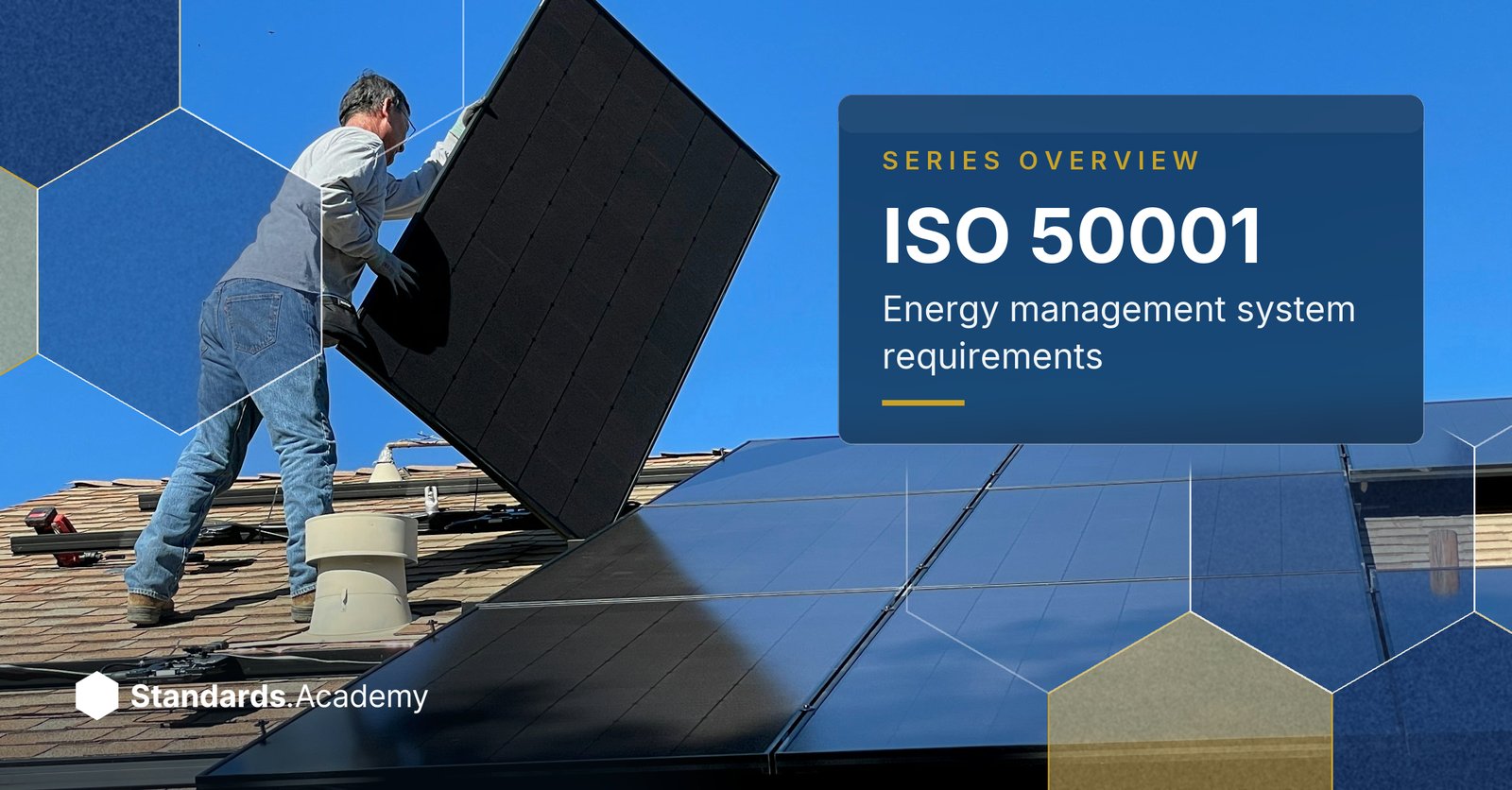
ISO 50001:2018 specifies requirements for establishing, implementing, maintaining and improving an energy management system (EnMS), and its central requirement is continual improvement of energy performance (ISO, 2018). The standard is in its second edition, published in August 2018 and confirmed in 2024, and was amended in 2024 to add climate-related considerations (ISO, 2024). Energy performance improvement is a conformity requirement; cost reduction is not promised by the standard. The two decisions behind this article, whether to implement the standard and which credential a role requires, rest on the same technical vocabulary of energy review, energy baseline and energy performance indicator, defined in the standard and elaborated in supporting documents such as ISO 50002-1:2025 and ISO 50006:2023 (ISO, 2023; ISO, 2025a).
Standards Academy teaches ISO 50001 as one of the systems through which management delivers the governing body's commitments on resources and viability. ISO 37000, written in ISO/TC 309/WG 1 under the convenorship of Standards Academy's director, makes viability and performance over time, without compromising the ability of future generations to meet their needs, a governing-body principle (ISO, 2021, Clause 6.11); energy performance is one of the measures by which that principle is given effect.
Scope and purpose of ISO 50001
ISO 50001:2018 applies to organizations of any size, sector or geographical location (ISO, 2018). The standard covers energy use and consumption within the scope and boundaries that the organization defines for its energy management system. It does not prescribe energy performance targets; each organization sets its own objectives and measurable energy targets within its energy policy.
The stated purpose of the standard is to enable a systematic approach to achieving continual improvement of energy performance and of the EnMS itself (ISO, 2018). Conformity requires demonstrated energy performance improvement over time, measured against an energy baseline. The standard does not require any particular level of improvement, and it does not promise cost reduction; financial outcomes depend on energy prices, investment decisions and operating conditions outside the standard's scope.
The standard was developed by ISO/TC 301, whose scope is "Standardization in the field of energy management and energy savings" (ISO, no date). On 23 October 2026 the committee page listed 22 published standards and three under development (ISO, no date). The published portfolio includes the energy audit series ISO 50002-1:2025 (general requirements), ISO 50002-2:2025 (buildings) and ISO 50002-3:2025 (processes), the implementation guidance in ISO 50004:2020, and the guidance on baselines and indicators in ISO 50006:2023 (ISO, 2020; ISO, 2023; ISO, 2025a; ISO, 2025b; ISO, 2025c).
Organizational certification against ISO 50001 is issued by an accredited certification body following an audit of the EnMS. ISO itself does not certify organizations, and no training provider or credential body performs organizational certification. An organization may also declare conformity without third-party certification, though certification by an accredited body is the recognized route for external assurance.
PECB credentials and training routes for energy management
PECB credentials attest personal competence; they are separate from organizational certification, which only an accredited certification body can grant. Three ISO 50001 training routes exist, each aligned to a distinct role in the energy management system.
The Foundation route covers EnMS principles: energy policy, performance measurement, internal audit, management review and continual improvement. It suits professionals who support an EnMS without leading it, procurement staff, facilities coordinators, sustainability analysts and managers who approve energy objectives. The Lead Implementer route develops competence to establish, implement, manage and maintain an energy management system, and corresponds to the person who owns the EnMS project from gap analysis through to certification readiness. The Lead Auditor route develops competence to plan and conduct audits of EnMS conformity, whether as an internal auditor, a second-party auditor of suppliers, or an auditor working for a certification body.
| Role | Credential | Course | Formats |
|---|---|---|---|
| Supporting role in an EnMS: general understanding of requirements | PECB Certified ISO 50001 Foundation | ISO 50001 Foundation | Self-Study and eLearning |
| Responsible for establishing, implementing and maintaining the EnMS | PECB ISO 50001 Lead Implementer | ISO 50001 Lead Implementer | Self-Study and eLearning |
| Responsible for auditing EnMS conformity | PECB ISO 50001 Lead Auditor | ISO 50001 Lead Auditor | Self-Study and eLearning |
A professional who will build the system chooses the ISO 50001 Lead Implementer route; a professional who will assess systems built by others chooses the Lead Auditor route. The two credentials cover the same standard from the implementer's and the auditor's positions, and neither substitutes for the other.
Organizations and roles within scope
The organization defines the scope and boundaries of its energy management system, including the sites, facilities, processes, equipment, energy sources and activities covered (ISO, 2018). One constraint applies: the organization shall not exclude an energy type within the scope, and it shall not exclude energy uses or consumption that it can control or influence in a way that undermines energy performance improvement.
Several roles carry defined responsibilities within an EnMS:
Top management demonstrates leadership and commitment, sees that the energy policy and objectives are established and compatible with strategic direction, and provides the resources the EnMS needs (ISO, 2018).
The energy management team has responsibility and authority for implementing the EnMS and delivering energy performance improvement. ISO 50001:2018 requires a team (Clause 5.3); a single individual may constitute it in smaller organizations.
Energy planners and technical staff conduct the energy review, analyse consumption data, identify significant energy uses and quantify improvement opportunities.
Operations and maintenance personnel apply the operational controls and criteria set for significant energy uses.
Procurement and design personnel evaluate energy performance over the expected operating lifetime when procuring energy-using products, equipment and services, and consider energy performance improvement opportunities in the design of new, modified or renovated facilities and processes (ISO, 2018).
Internal auditors evaluate whether the EnMS conforms to the standard and to the organization's own requirements, and whether it is effectively implemented.
Employees and contractors working under the organization's control follow documented procedures and contribute to energy objectives.
Training demand maps onto these roles. Technical staff and team members who support the system are served by Foundation-level ISO 50001 training; the team leader needs implementer competence; internal auditors need auditor competence.
Requirements of an energy management system
ISO 50001:2018 follows the harmonized structure used across ISO management-system standards, with requirements organized in Clauses 4 to 10 (ISO, 2018).
Clause 4, Context of the organization. The organization determines external and internal issues relevant to its purpose and affecting its ability to improve energy performance, identifies interested parties and their relevant requirements, and defines the scope and boundaries of the EnMS.
Clause 5, Leadership. Top management establishes an energy policy, assigns responsibilities and authorities, and sees that an energy management team is formed.
Clause 6, Planning. The organization addresses risks and opportunities, sets energy objectives and energy targets, and plans actions to achieve them. Clause 6 contains the energy review, the energy baseline, the energy performance indicators and the energy data collection plan, the analytical requirements treated in the next section.
Clause 7, Support. Requirements cover competence, awareness, communication and documented information. Persons doing work affecting energy performance shall be competent on the basis of education, training, skills or experience.
Clause 8, Operation. The organization plans and controls the processes related to its significant energy uses, and considers energy performance in design and in procurement of energy-using products, equipment, services and energy itself.
Clause 9, Performance evaluation. The organization monitors, measures, analyses and evaluates energy performance and the EnMS, including EnPIs compared against the energy baseline, conducts internal audits at planned intervals, and carries out management review.
Clause 10, Improvement. Nonconformities require correction and corrective action, and the organization shall continually improve the suitability, adequacy and effectiveness of the EnMS and demonstrate continual energy performance improvement (ISO, 2018).
ISO 50004:2020 provides guidance on implementing, maintaining and improving an EnMS under ISO 50001:2018, including practical help on the energy review, data collection and performance evaluation (ISO, 2020).
Energy review, baseline and energy performance indicators
Energy performance is the measurable result related to energy efficiency, energy use and energy consumption (ISO, 2018). An energy baseline (EnB) is a quantitative reference providing a basis for comparison of energy performance over time (ISO, 2018). An energy performance indicator (EnPI) is a measure or unit of energy performance, as defined by the organization (ISO, 2018).
The energy review is the analytical core of Clause 6. It analyses energy use and consumption based on measurement and other data to identify significant energy uses (SEUs), determine the relevant variables affecting them, establish current energy performance, and identify and prioritize opportunities for improvement (ISO, 2018). Relevant variables include factors such as production volume, weather, operating hours and occupancy, anything that affects energy consumption independently of how well energy is managed.
The baseline is normally constructed from historical data covering a defined period. Where relevant variables change, the baseline may be normalized so that comparisons reflect genuine performance change. ISO 50006:2023 provides detailed guidance on establishing energy baselines, selecting EnPIs and normalizing for relevant variables (ISO, 2023). Typical EnPIs include kWh per unit of production, energy use per square metre, energy consumption per operating hour, and total energy consumption or energy intensity.
The organization shall monitor EnPIs against the energy baseline and investigate significant deviations in energy performance (ISO, 2018). Measurable improvement is demonstrated when the normalized EnPI value shows improvement relative to the baseline.
Energy audits complement the internal energy review. ISO 50002-1:2025 specifies requirements and provides guidance for conducting energy audits, with Part 2 covering buildings and Part 3 covering processes (ISO, 2025a; ISO, 2025b; ISO, 2025c). An energy audit under ISO 50002 can supply the data and opportunity analysis that an EnMS energy review draws on, whether or not the organization pursues ISO 50001 certification.
Amendment 1:2024 and relationship with ISO 14001
ISO 50001:2018/Amd 1:2024, titled "Climate action changes" and published in February 2024, is the current amendment to the standard (ISO, 2024). Under the amendment, the organization determines whether climate change is a relevant issue when it establishes the context of its EnMS, and considers whether relevant interested parties have requirements related to climate change (ISO, 2024). The amendment introduces matching changes across ISO management-system standards, including ISO 14001, so that climate considerations enter the context analysis of each system on the same basis. No other requirements of ISO 50001:2018 are altered by the amendment (ISO, 2024).
ISO 50001 and ISO 14001 share the harmonized structure used across ISO management-system standards: the same clause numbering, common terminology and compatible requirements for documented information, internal audit and management review. Within an environmental management system, energy is one environmental aspect among others. ISO 14001 addresses environmental performance across all aspects an organization controls or influences, while ISO 50001 addresses energy performance in depth, with the energy review, baseline and EnPI requirements that ISO 14001 does not contain. Certification to one standard does not demonstrate conformity with the other, and an organization holding both certifications is audited against both sets of requirements, though integrated audits are common.
Standards Academy teaches both standards from the governing body's commitments downwards, so that the energy review and the environmental aspects register can be shown to serve the organization's stated purpose and its viability over time.
Frequently asked questions
What is an energy performance indicator?
An energy performance indicator is a measure or unit of energy performance that the organization defines (ISO, 2018). An example is energy consumed per unit of output. The organization tracks each indicator against its energy baseline. Indicators are normalized for the variables that affect consumption. ISO 50006:2023 gives guidance on choosing and using them (ISO, 2023).
Which credential suits an energy manager and which an auditor?
A supporting role needs the Foundation credential. The person responsible for establishing and maintaining the EnMS needs the ISO 50001 Lead Implementer credential. A person auditing EnMS conformity, internally or for a certification body, needs the Lead Auditor credential. The decision table under heading 2 sets out the three routes.
What does ISO 50001 require?
ISO 50001:2018 requires an energy policy, an energy review identifying significant energy uses, an energy baseline, energy performance indicators, objectives and targets, operational controls, energy-aware design and procurement, monitoring, internal audit, management review, corrective action and continual improvement of energy performance (ISO, 2018). Requirements follow the harmonized Clauses 4 to 10.
What is an energy baseline?
The organization defines EnPIs, establishes a baseline from historical data, and normalizes for relevant variables such as production volume, weather or occupancy where they affect consumption. EnPI values are compared with the baseline, and significant deviations are investigated (ISO, 2018). ISO 50006:2023 gives detailed guidance (ISO, 2023).
What did Amendment 1:2024 change?
Amendment 1:2024, titled "Climate action changes", requires the organization to determine whether climate change is a relevant issue in the context of the EnMS and whether interested parties have requirements related to climate change (ISO, 2024). Matching changes were made across ISO management-system standards, including ISO 14001.
Who certifies an organization to ISO 50001?
An accredited certification body certifies organizations to ISO 50001 following an audit of the energy management system. ISO does not certify organizations, and personal credentials such as PECB certificates attest individual competence only. An organization may also self-declare conformity without third-party certification, though accredited certification provides external assurance.
References
International Organization for Standardization (2018) ISO 50001:2018 Energy management systems, Requirements with guidance for use. Geneva: ISO. Available at: https://www.iso.org/standard/69426.html (Accessed: 23 October 2026).
International Organization for Standardization (2024) ISO 50001:2018/Amd 1:2024 Energy management systems, Requirements with guidance for use, Amendment 1: Climate action changes. Geneva: ISO. Available at: https://www.iso.org/standard/88430.html (Accessed: 23 October 2026).
International Organization for Standardization (2025a) ISO 50002-1:2025 Energy audits, Part 1: General requirements with guidance for use. Geneva: ISO. Available at: https://www.iso.org/standard/83645.html (Accessed: 23 October 2026).
International Organization for Standardization (2025b) ISO 50002-2:2025 Energy audits. Part 2: Guidance for conducting an energy audit using ISO 50002-1 in buildings. Geneva: ISO. Available at: https://www.iso.org/standard/83662.html (Accessed: 23 October 2026).
International Organization for Standardization (2025c) ISO 50002-3:2025 Energy audits. Part 3: Guidance for conducting an energy audit using ISO 50002-1 in processes. Geneva: ISO. Available at: https://www.iso.org/standard/83663.html (Accessed: 23 October 2026).
International Organization for Standardization (2020) ISO 50004:2020 Energy management systems, Guidance for the implementation, maintenance and improvement of an ISO 50001 energy management system. Geneva: ISO. Available at: https://www.iso.org/standard/74863.html (Accessed: 23 October 2026).
International Organization for Standardization (2021) ISO 37000:2021 Governance of organizations. Guidance. Geneva: ISO. Available at: https://www.iso.org/standard/65036.html (Accessed: 23 October 2026).
International Organization for Standardization (2023) ISO 50006:2023 Energy management systems, Evaluating energy performance using energy performance indicators and energy baselines. Geneva: ISO. Available at: https://www.iso.org/standard/79367.html (Accessed: 23 October 2026).
International Organization for Standardization (no date) ISO/TC 301 Energy management and energy savings. Available at: https://www.iso.org/committee/6077221.html (Accessed: 23 October 2026).